

Survey: Free Dates, Promotional Events, and Who’s Paying
A journalist went on a date that turned into a surprise promotional wine tasting after last-minute schedule changes – complete with a scheduled photoshoot neither person had agreed to. The story sparked a question worth asking: how do American daters actually feel about free or promotional events as date settings? And, with the average all-in cost of a date now hovering close to $200, is a free event really such a bad idea?
Hily surveyed 5,400 Gen Z and Millennial American daters to find out. The results touch on transparency, financial expectations, and what a free event says (or doesn’t) about the person who suggested it.
Here are some key findings from our survey:
- More than 1 in 3 Gen Z and 2 in 5 Millennial daters have suggested a free event as a date idea
- More than a quarter of daters who went on a date at a free or promotional event didn’t know in advance that’s where they were going
- 47% of Gen Z and 54% of Millennial daters would go to a free or promotional event for a date
- Over 50% of Gen Z and Millennial women think if someone can’t pay for their part of a date, they shouldn’t ask anyone out
Free Dates Are More Common Than Expected

About 17% of Gen Z and 25% of Millennial daters have been asked on a date at a free or promotional event. Millennials are notably more likely to have encountered this – possibly a reflection of more years of dating, or a greater willingness to suggest unconventional settings.

About 15% of Gen Z and 25% of Millennial daters have actually gone on one. The numbers track closely with those who were asked, which suggests most people who get the invitation say yes.

Not everyone knew what they were walking into, though. More than a quarter of daters who attended a free or promotional event date say they weren’t told in advance. The surprise element – wine tasting with a photoshoot, or otherwise – is something a fair share of Gen Z and Millennial daters have experienced firsthand.
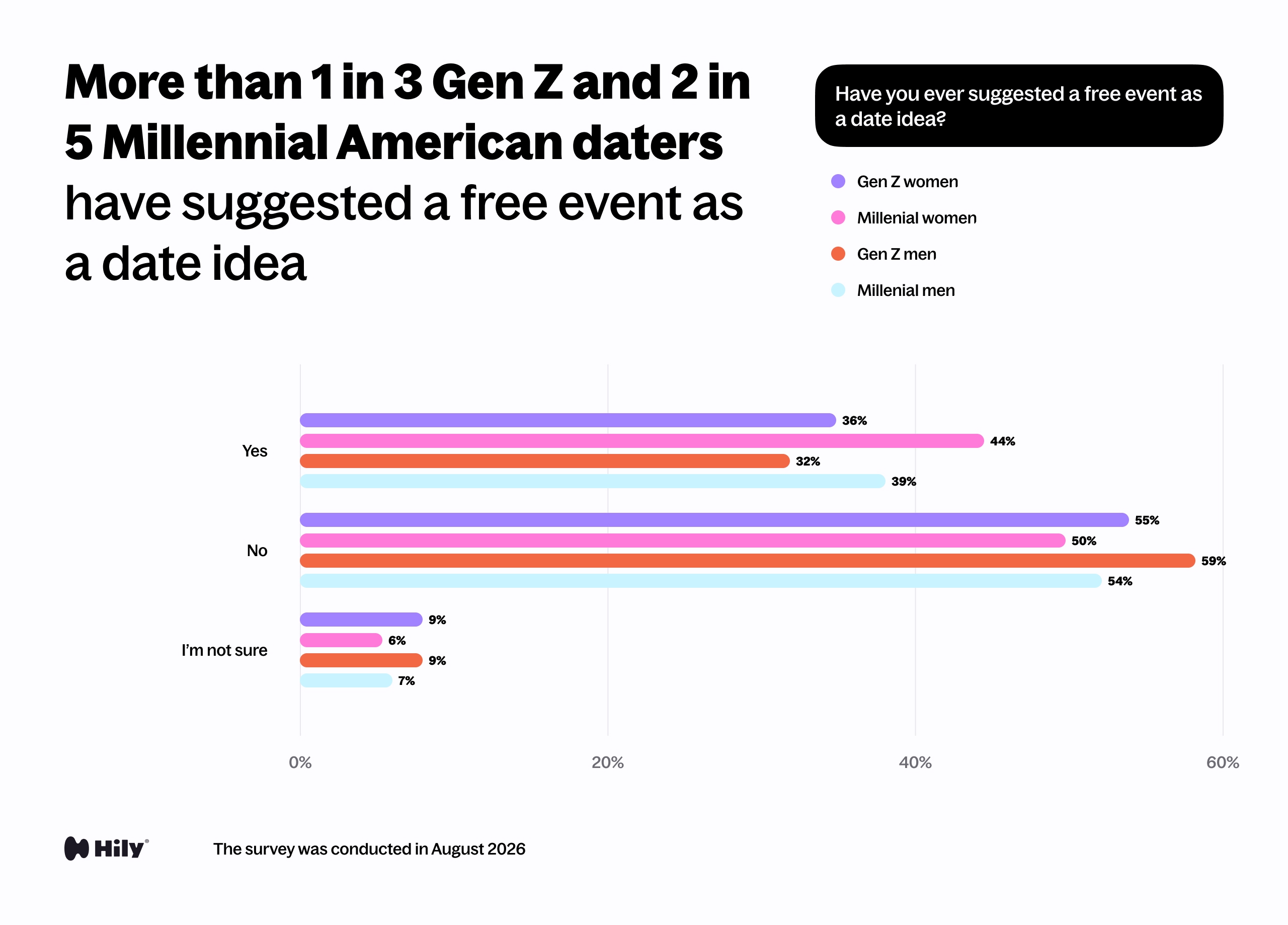
On the other side of the equation, more than 1 in 3 Gen Z and 2 in 5 Millennial daters have suggested a free event as a date idea themselves. Free event dates aren’t a niche move – they’re something a significant share of daters have actively proposed.
The Reason Is Usually Pretty Simple

The most common reason for suggesting a free event is simple: they were already going. 43% of Gen Z and 45% of Millennial daters who’ve done it say they would have gone to the event anyway. It’s less a calculated budget decision and more a case of being pragmatic and combining two things that were already happening.

Among those who’ve suggested a free event date, 77% of Gen Z and 85% of Millennial daters say they made it clear upfront. The majority are transparent about it – but a notable minority aren’t, which aligns with the share of daters who’ve shown up somewhere unexpected.
One Venue, Several Interpretations

18% of Gen Z women and 14% of Millennial daters think a free or promotional event might signal a lack of interest from the person who suggested it. It’s a minority view, but it exists; the setting is being read as a signal about enthusiasm and potential investment, not just logistics.

20% of Gen Z women and 15% of Millennial daters think a free event choice reflects financial difficulty on the other person’s part. Again, not the majority interpretation, but for a portion of daters, the choice of setting prompts questions about circumstances rather than creativity.

Employment status, at least, isn’t the deciding factor for most. More than half of Gen Z and more than two-thirds of Millennial daters don’t think a person’s employment status affects whether a free first date is appropriate. The appropriateness of a free date is being evaluated on factors other than whether someone has a job.

Despite some reservations, 47% of Gen Z and 54% of Millennial daters say they would go to a free or promotional event for a date. Openness to the idea is higher than the hesitation around what it might signal.Free doesn’t automatically mean disinterested. For most daters, it just means free.
The Bigger Question Behind the Free Date

Views on financial responsibility for dates split noticeably along gender lines. 35% of Gen Z women and 48% of Millennial women think someone who can’t pay for the entire date shouldn’t ask anyone out, compared to 26% of Gen Z men and 29% of Millennial men. Millennial women hold this view more strongly than any other group – showing a generational and gender divide.

The bar shifts when the question is about covering one’s own share rather than the whole thing. More than 50% of Gen Z and Millennial women think someone who can’t pay for their own part of the date shouldn’t ask anyone out, with Gen Z and Millennial men at 47% and 45% respectively. Across all groups, not being able to cover your own portion draws more consensus than not being able to cover everything.

Financial expectations aren’t only placed on the person asking. 26% of Gen Z and Millennial women and 17% of Gen Z and Millennial men think that if someone can’t pay for the entire date, they shouldn’t accept the invitation either. A smaller but consistent share of daters think the responsibility runs both ways.

When the question is about covering one’s own portion, the numbers rise. 50% of Gen Z women and 46% of Millennial women think someone who can’t cover their part of the date shouldn’t accept – with Gen Z and Millennial men at 30% and 29% respectively. Women hold stronger views on this across both the asking and accepting sides.
Free Setting, Loaded Expectations
A free date isn’t inherently a bad date. Most daters would go to a free or promotional event, and most people who’ve suggested one had a fairly simple reason for doing it. The bigger issue, for a meaningful share of daters, is the transparency around it – showing up somewhere unexpected is a different experience than being invited somewhere unusual.
The financial questions underneath the free date debate are more layered. Views on who should pay, who should cover what, and what financial limitations mean for whether someone should be dating at all vary significantly by both gender and generation. The free event is just the surface. The assumptions underneath it go further.